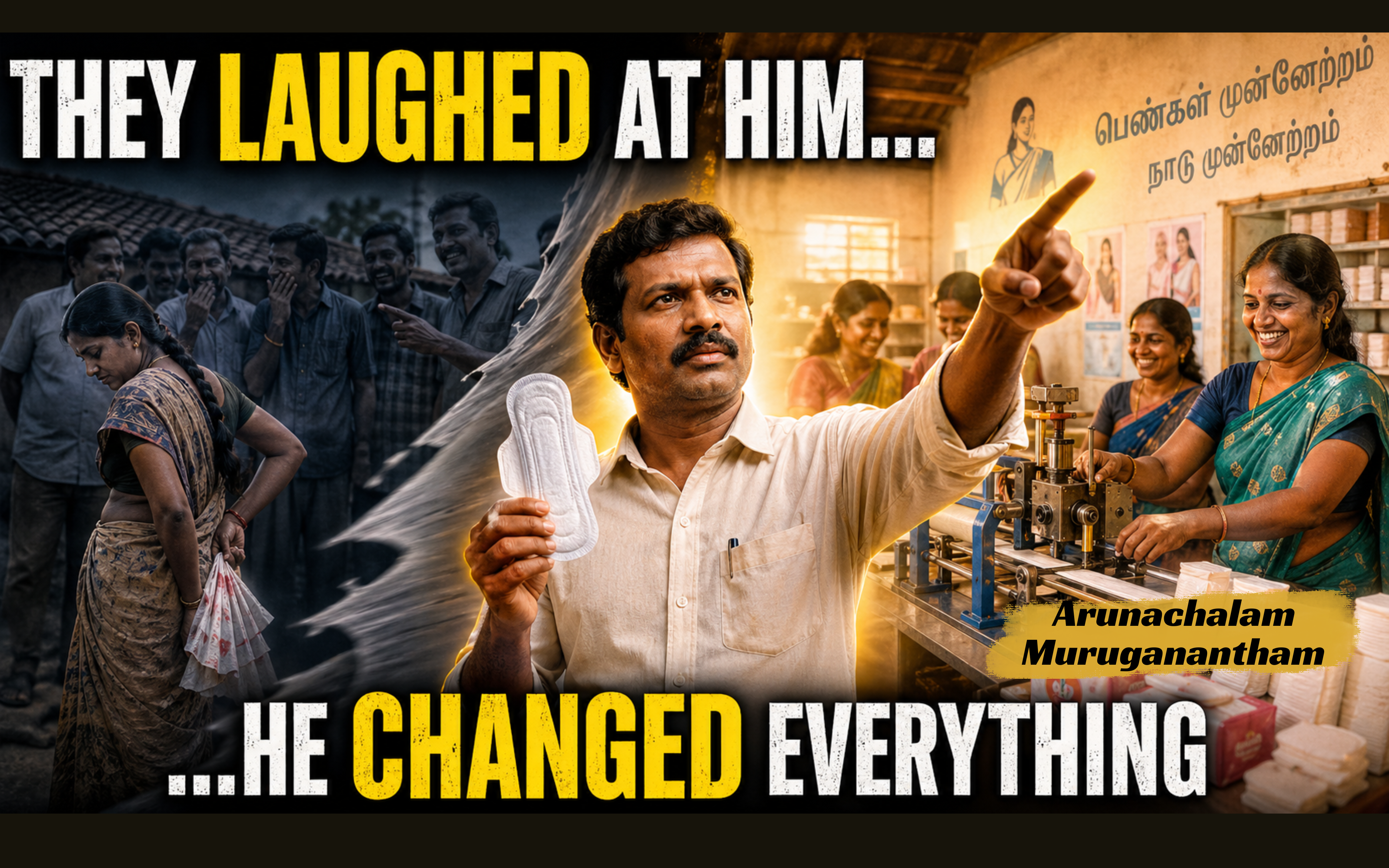
THE MAN WHO REFUSED TO IGNORE A SIMPLE PROBLEM
How a question turned into an innovation that people first rejected
It started in a place where nothing seemed wrong.
There was no visible crisis. No urgency. No conversation that demanded attention.Just a routine.
A piece of cloth, quietly used and washed, then dried in a way that ensured it was not seen. Hidden not just physically, but socially.
It was not something people discussed. Which is why it survived unquestioned. He noticed it not as a social issue, but as a mismatch. Something about it did not align with how the world otherwise worked. If better options existed, why weren’t they being used?
That question could have been answered quickly. People could say: “It’s tradition.” “It’s normal.” “It’s how things are done.” And those answers are convenient. Because they close the inquiry But he did not accept those answers, not because he had a better one, but because they didn’t fully explain the behavior. If something better exists and is not being used, there is always a constraint.
The question is: what kind? He asked directly. The answer was simple. Pads are expensive. Now something shifts. The problem is no longer abstract. It is precise.
But precision creates responsibility. Because now the problem is not hidden behind complexity. It is sitting in front of you, clear and direct. And that creates discomfort. Because if the problem is simple,
the next question becomes unavoidable: “If it is just about cost… can it be reduced?” At this point, most people exit. Because moving forward means entering unfamiliar territory. He did not. Not with confidence. Not with a plan. But with a decision that was more instinctive than strategic. He decided to try.
The first step was imitation. He bought a sanitary pad. Opened it. Looked inside.
This moment is important. Because this is where perception begins to shape direction. What he saw looked like cotton. And that created a mental shortcut: “This is not complicated.
That assumption was both necessary and misleading. Necessary—because without it, he might not have started. Misleading—because it was incomplete. He tried to recreate it Used cotton. Shaped it. Made a version. Now came the first real confrontation with reality. Does it work?
This is where theory ends and feedback begins. But feedback required participation. And participation required crossing a social boundary that was not easily crossed.
The people who could validate the product were not comfortable engaging in the process. Not because they didn’t need the solution. But because the process of testing itself violated an unspoken boundary.
So now, the problem had two layers:
- The product didn’t work properly
- The system didn’t allow easy feedback
This is where most efforts collapse quietly. Not with failure, but with friction. Because now the question becomes: “Is this worth continuing?” He could have stopped here. And it would have made sense. Instead, he shifted the question. “If I cannot get feedback from others, how can I generate feedback myself?”
That shift is subtle. But it changes everything. Instead of waiting for cooperation, he begins designing around the lack of it. He created a crude simulation. Something that could replicate the conditions under which the product would be used. It was imperfect. Uncomfortable. Even strange.
But it solved one problem: It gave him a feedback loop. Now failure became useful. Because each failed attempt revealed something specific. Absorption was insufficient. Structure was weak. Leakage occurred. Now the process becomes iterative. Try → fail → adjust → try again. But this is also where the external environment begins to react.
His actions did not look normal. They did not fit into socially accepted behavior. People around him began to question—not the problem, but his actions. And this is where the problem changes form again. It is no longer: “Can this be solved?” It becomes: “Can this be pursued without losing social acceptance?”
This is a different kind of pressure. More subtle. But more powerful. Because it does not attack the idea. It isolates the person. At this stage, most people withdraw. Not because the idea is wrong. But because the cost of continuing becomes personal. He did not withdraw. Not because he was immune. But because the problem had not resolved.
This is important. He was not driven by ambition. He was held by the question. As experiments continued, a pattern began to emerge. The material he was using did not behave like the original. This forced a deeper inquiry. “What exactly is inside the original pad?”
The initial assumption—cotton—began to break. And when an assumption breaks, there are two choices: Replace it with another guess Or investigate further He chose to investigate. Eventually, he discovered that the core material was processed cellulose fiber. Now the problem expanded. Because the solution was no longer about shaping cotton. It was about accessing and processing a different material.
And that material came with its own constraints.
- It required processing
- It required machinery
- It required capital
Now he faced a structural limitation.
He could try to replicate the industrial process.
- High cost
- Technical complexity
- Dependency on scale
Or he could try something else.
Break the process down. Understand it step by step. And rebuild it in a simpler form. But it was the only path available to him. So he began decomposing the problem.
Instead of asking: “How do I build a sanitary pad?” He began asking:
“What are the essential steps involved?”
- Material preparation
- Fiber separation
- Shaping
- Compression
- Packaging
Now each step could be examined independently.
- What is necessary?
- What can be simplified?
- What can be done manually?
- What needs minimal machinery?
This is where the nature of the solution shifts. From product replication To process design He started building small machines. Not efficient by industrial standards. But functional.
Machines that could:
- Process the material
- Shape the pad
- Maintain basic quality
Now something important happens.
The solution becomes: Accessible. Not perfect. Not identical to industrial products. But usable. And usability matters more than perfection in constrained environments. Now comes another layer.
Even if the product works, How does it reach people? Because a solution that exists but does not reach users is incomplete. He could have built a business. Centralized production. Distributed at scale.
But that would reintroduce the same problem: Cost. So he looked at it differently. “What if production itself is decentralized?” Instead of: One center → many consumers He imagined: Many small producers → local consumers Now the model changes completely
Machines are placed in villages. Women operate them. They produce for their own communities. Now observe what happens: The user becomes the producer.
This aligns multiple elements:
- Access improves
- Cost reduces
- Ownership increases
And something else happens. The problem is no longer external. It becomes embedded in the community. Which means the solution sustains itself. At this stage, the system stabilizes. Not because everything is perfect.
But because:
- It works
- It continues
- It does not depend on one person
Looking back, it might seem like a sequence.Clear. Logical. Directed.
But inside the process, nothing was clear.
At every stage:
- The understanding was partial
- The direction was uncertain
- The feedback was incomplete
- The resistance was real
There was no moment where the full solution was visible.
Only the next step. And that step was always taken without full certainty. That is what defines this entire journey.
- Not intelligence.
- Not expertise.
- Not resources.
- But continuity
Staying with the problem long enough for the problem to reveal what it actually is
Because the problem he started with— A piece of cloth— Was never just about that.
It was about:
- Cost
- Access
- Social norms
- Production systems
- Distribution
And each layer only revealed itself because he did not stop at the first answer
That is how the solution emerged. Not as a single idea. But as a sequence of corrections. And that is why it worked.