The Man Who Grew A Forest
how a solution actually unfolds in real life
The river had just receded.
What it left behind was not land—it was silence.
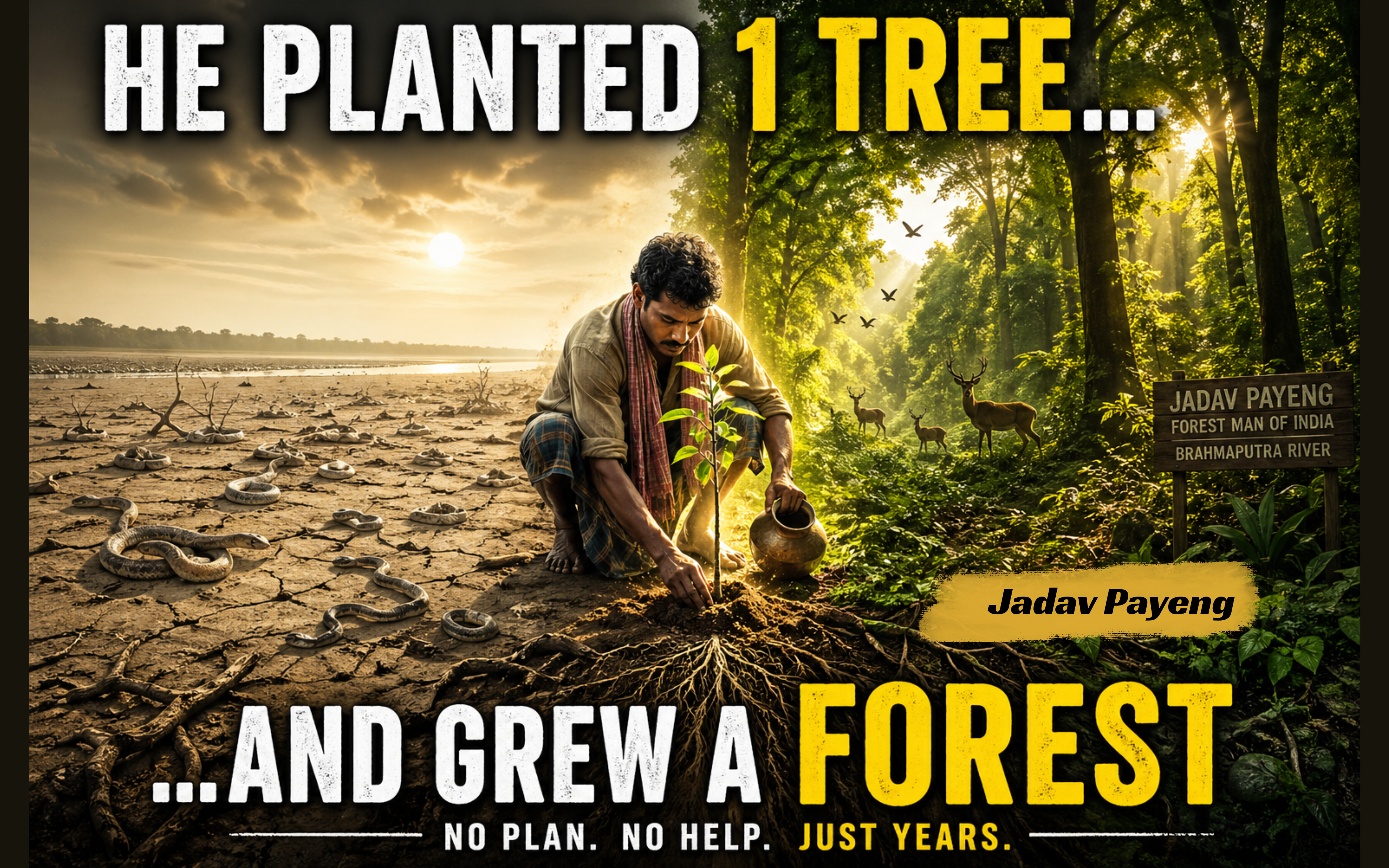
A stretch of sand, dry and lifeless, lay exposed under the harsh sun along the Brahmaputra. There were no trees, no shade, no sound of birds. Just heat, wind, and emptiness.
This was India in the 1970s. A country where millions were going blind… for a condition that could be cured in 15 minutes A young boy walked across that land.
His name was Jadav.
And that day, he noticed something most people would have ignored There were snakes Not moving. Not alive They had died—not because of predators, but because there was nowhere to hide. No shade.No cover. No ecosystem.
And he asked a question that most people didn't: "If we know how to cure this, why are people still blind?"
That moment did not look like a “problem statement.”It looked like discomfort. Something felt wrong.And that is where most solutions actually begin
The First Shift: From Seeing to Feeling.
Jadav did not think in terms of climate change or biodiversity loss. He didn’t have data. He didn’t have language. But he had clarity. “This land cannot support life.” That was enough. Most people wait for a complete understanding before acting. He didn’t. He simply asked himself: “If there were trees here, would this be different?” That question became the seed of everything that followed.
The Second Shift: Choosing the First Move.
Planting a forest sounds like a massive idea. But Jadav did not try to plant a forest. He planted bamboo. Not because it was grand—but because it was possible. Bamboo grows fast. It holds the soil. It survives harsh conditions. It creates the first layer of protection. This is where his thinking becomes important. He didn’t ask: “How do I solve deforestation?” He asked: “What is the first thing this land needs to survive?” And the answer was simple: Something that can grow here.
The Third Shift: From Action to Routine.
The first plant did not change anything. Neither did the second. Or the tenth. If someone had seen him in those early days, it would have looked meaningless. A boy planting a few saplings on an endless stretch of sand. There was no visible impact. And yet, he kept coming back. Every day. Not with excitement. Not with motivation speeches. Just with quiet consistency. This is where most people stop. Because the effort does not match the visible result. But Jadav was no longer chasing results. He had entered a different mode. This was no longer an “effort.” It had become a way of living.
The Fourth Shift: Letting the System Take Over.
Something began to change. Slowly, the bamboo held the soil. The soil started retaining moisture. Moisture allowed other plants to survive. Then birds came. And birds did something Jadav never planned for. They brought seeds. Now, trees started growing that he had never planted. This is the turning point most people don’t understand. He did not “build” the forest. He created the conditions for the forest to build itself
The Fifth Shift: Working Without Witness.
Years passed. No one came to appreciate him. No one documented his work. No one funded him. The land was still isolated. His work was invisible. But the forest was growing. At this stage, a different kind of strength is required. Not physical. Not even intellectual. It is the ability to continue without validation. Because when you are solving a real problem, recognition always comes late.
The Sixth Shift: When Impact Becomes Visible.
Decades later, what stood there was no longer a sandbar. It was a forest. Dense. Alive. Breathing. Animals returned—deer, elephants, birds. The land that once killed life was now sustaining it. Only then did people notice. Only then did the story begin to spread. But by then, the solution had already been completed.
What Actually Happened Here?
Not a miracle. Not a heroic act.
- A problem was felt, not studied
- A solution was started small, not imagined big
- An action was repeated, not celebrated
- A system was allowed to grow, not controlled
- Recognition was ignored, not chased
And slowly, without noise, a forest emerged.
Why This Matters for US
Because most people are waiting for:
The system funded itself. Not through donations. But through design.
- A big idea
- A perfect plan
- The right resources
- The right time
But this story quietly shows something else. You don’t solve problems by jumping to the end.
You solve them by asking:
- What is missing right now?
- What is the smallest thing I can start?
- Can I do it again tomorrow?
And then… not stopping.
The Real Lesson
The forest was never planted in a day. It was planted in thousands of ordinary days where nothing seemed to be happening. That is how real solutions are built. Not in moments. But in continuity.