THE BEACH THAT CHANGED HOW PEOPLE THINK
The first thing that struck him was not the scale of the garbage.
It was the stillness.
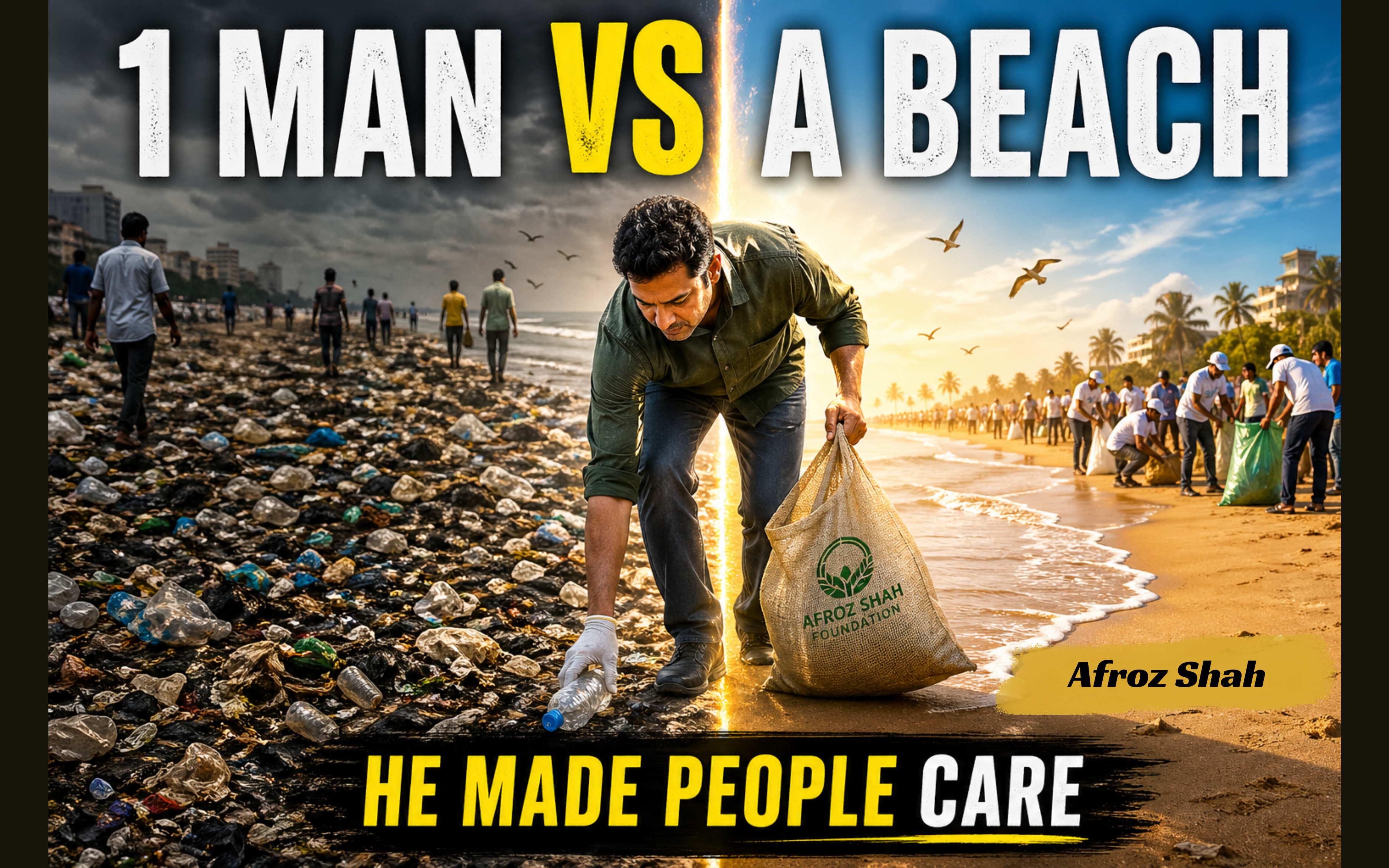
The sea was there, but it did not feel alive. The waves reached the shore and stopped—not against sand, but against layers of plastic that had hardened into something almost permanent. There was no line where the beach began. Just waste. Thick. Unbroken. Settled. People walked past it.
Some slowed down for a second, looked, and moved on. Others didn’t even turn their heads. It had become part of the city’s background—like traffic, like noise, like something you stop noticing after a while.
And that was the real problem. Not the garbage. But the fact that it no longer disturbed anyone enough to act.
He stood there longer than most. Not because he had a solution. Not because he was trying to think of one. Just because leaving felt incomplete. There was a discomfort that didn’t resolve itself. It stayed.
On the way back, his mind tried to settle it.
- “This is too big.”
- “This is a municipal issue.”
- “This needs policy, not individuals.”
Each of these thoughts was correct. And each of them quietly removed him from the situation
Because once something becomes “too big,” it also becomes “not mine.” The next day, he returned. Nothing had changed.
The plastic was still there. The same thickness. The same smell. The same indifference around it. Which meant the same question stood again: What can be done?
There were options. He could file a complaint. He could raise awareness. He could post about it, talk about it, gather opinions. All of these would have been reasonable first steps. And none of them would have required him to touch the problem directly.
Instead, he bent down. Picked up one piece of plastic. Then another.
From a distance, it looked pointless. One person removing a few pieces from a mass that stretched endlessly. The scale did not match. And when scale does not match effort, the mind usually concludes: “This is ineffective.”
He must have known that. But the action was not trying to solve the entire problem. It was trying to do something else. Something less visible, but more important. Break the stillness.
For the first hour, nothing changed. For the second hour, nothing changed. At the end of it, the beach looked exactly the same. If someone had come there that evening, they would not have noticed any difference
That night, the thought returned. “This is too big.” But now there was another thought, quieter but stronger: “Not doing anything feels worse.” So he went back.
The second day was the same. Pick. Move. Fill. Shift. The third day, the same. The fourth day, the same. Nothing changed.
Which is what makes this phase difficult. Because effort without visible outcome creates a very specific kind of pressure. Not failure. But doubt.
At this point, the logical thing to do is to change approach. Move from action to awareness. From effort to advocacy. Because action is not producing results.
But he didn’t change. He continued. Not because he believed it would work. But because stopping would confirm something he had not yet accepted: “That nothing can be done.”
Days passed. Then something subtle began to shift. Not on the beach. But around it. People began to notice. At first, just glances. A man walking his dog slowed down slightly.
A group of boys laughed as they passed. A couple stopped for a moment, watched, and moved on. No one joined. But people saw. And in social systems, that matters. Because change rarely begins with participation. It begins with observation.
People were not asking how to solve the problem. They were asking something else: “Why is this person doing this?” That question is important. Because it disrupts normal behavior. It creates curiosity.
One day, someone stopped. Stood for a few seconds. Then bent down. Picked up a piece of plastic. Stayed for a while. Left.
It was a small moment. Easy to miss. But it changed something fundamental. The action was no longer individual. It had been repeated by someone else. That is when behavior starts becoming contagious. Not because it is forced. But because it is seen.
Still, it didn’t grow immediately. Some days there were two people. Some days just one. Some days a few more. There was no pattern. No structure. No coordination. Which made it fragile.
Because early participation is unstable. People are testing, not committing. They come once. See how it feels.Leave.
At this stage, most efforts collapse. Not because people don’t care. But because there is no consistency. What held this together was not the number of people. It was the fact that the action did not stop. No matter who came or didn’t come, someone was there.
Weeks passed. Then, slowly, something changed on the ground. A small patch of sand became visible. Not the whole beach. Just a section. But that section mattered. Because it turned effort into evidence.
Until then, the belief was: “This cannot be cleaned.” Now there was proof:
“This part has been cleaned.”
That is enough to change behavior. Because belief does not shift with arguments. It shifts with visible reality.
More people began to join. Not because they were convinced. But because they had seen something change.
Some brought gloves. Some brought bags. Some stayed longer than they intended
The action remained simple. No speeches. No instructions. Just: Pick. Move. Clear.
And because it was simple, it was repeatable.
This is where another decision mattered. There was no attempt to control participation. No restriction on who could join.
No formal structure.
Which meant: Anyone could enter the process immediately. This reduced friction. And friction is what usually prevents participation. Now, something larger began to form. Action created visibility. Visibility created participation. Participation increased action.
A loop began. At some point, media noticed. Stories were written. Cameras came. But by then, the core of the work had already been done. Because media amplifies. It does not create. The beach began to change more visibly now
The shoreline reappeared. The sea met sand again. But the deeper change was not physical. It was behavioral.
Earlier, people saw garbage and walked past. Now they saw people cleaning. And that changed how they stood there.
They no longer felt separate from the problem.
Even before they acted, something had shifted internally.
Responsibility had moved. From system To self
Not as a burden. But as a possibility. The city had not transformed overnight. Waste was still being generated. Systems were still imperfect.
But one thing had changed irreversibly.
The belief that nothing can be done had broken.
And once that belief breaks,action becomes natural.
The beach did not become clean because one person worked hard. It became clean because one person made it difficult for others to remain passive. And that is how large problems begin to get solved. Not when the system changes first. But when behavior changes enough that the system is forced to respond.
What looked like a cleanup was not really about removing garbage. It was about removing indifference. And once indifference is removed, everything else begins to move. That is when a problem stops being permanent. And starts becoming solvable.